[ Sep
15-17
] Save the date for Autodesk 2026
 Email:
inquiry@srinsoft.engineering
 Phone:
+1 (614) 552-3888


 Add Us On Google
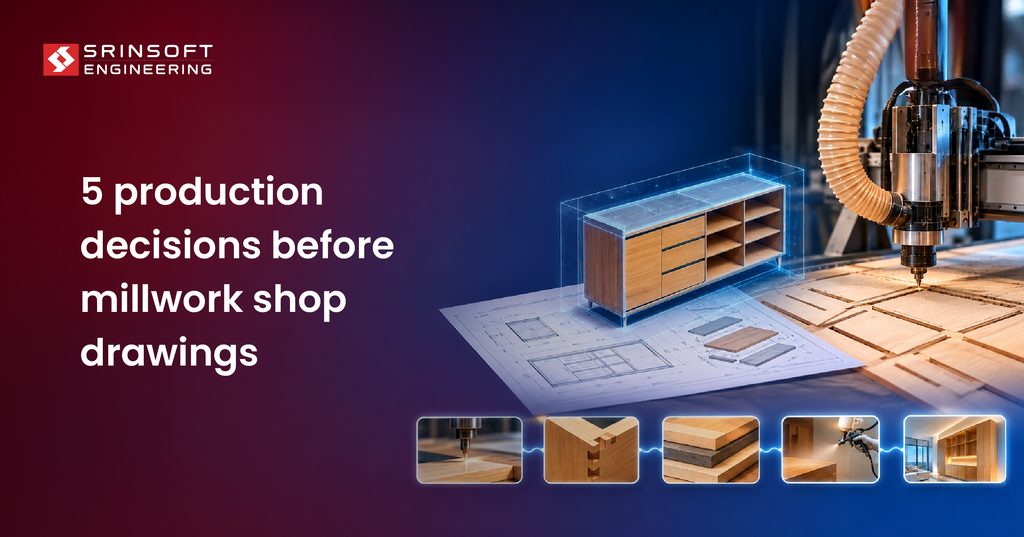
The saw doesn’t care what the drawing intended. It only cuts what the tooling allows.
That reality hits hardest when millwork shop drawings document geometry instead of machine capability – like thirty walnut credenzas stalling at the bench because stopped dados were detailed for a flatbed router without the tooling to cut them.
To protect margins before sheets hit the spoilboard, professional millwork drafting services should resolve five production decisions upfront:
1. Validate Manufacturing Equipment and Tooling Capabilities
2. Define Joinery and Assembly Methods Early
3. Finalise Material Selection and Optimisation Strategy
4. Establish Finishing Requirements Before Drafting
5. Plan for Installation and Field Conditions
Production-ready millwork drafting servicessettle all five before the first line is drawn.
Commercial Millwork Drafting Services
Commercial millwork projects demand more than precise dimensions and attractive designs. Success depends on how effectively design intent is translated into manufacturable, installable, and cost-efficient products. Too often, shop drawings focus solely on geometry while overlooking production realities such as machinery limitations, material behaviour, assembly requirements, and installation constraints.
As discussed above, before creating millwork shop drawings, project teams should make several critical production decisions. These early considerations help avoid costly revisions, improve manufacturing efficiency, and ensure a smoother path from design to installation.
Decision 1: Millwork Shop Drawings – Validate Manufacturing Equipment and Tooling Capabilities
The first production decision is identifying the equipment that will manufacture the project. Every machine has limitations related to cutting depth, tool diameter, workpiece size, and processing speed.
For example, a CNC router may not be capable of producing perfectly square internal corners without secondary operations. Similarly, intricate stopped dados, deep pockets, or specialised edge profiles may require tooling that is not available in-house.
Production Benefits:
- Reduces Shop-floor Modifications
- Eliminates Unnecessary Secondary Operations
- Improves Machining Efficiency
- Minimises Production Delays
Shop-Floor Impact:
When a millworker tackles a design with perfectly square internal corners, validating shop drawings against exact CNC limitations beforehand prevents mid-run failures. Adjusting the project to match in-house tooling instantly eliminates manual secondary operations. This completely stops unexpected shop-floor modifications, improves machining efficiency, and avoids costly production delays entirely.
Decision 2: Millwork Drafting – Define Joinery and Assembly Methods Early
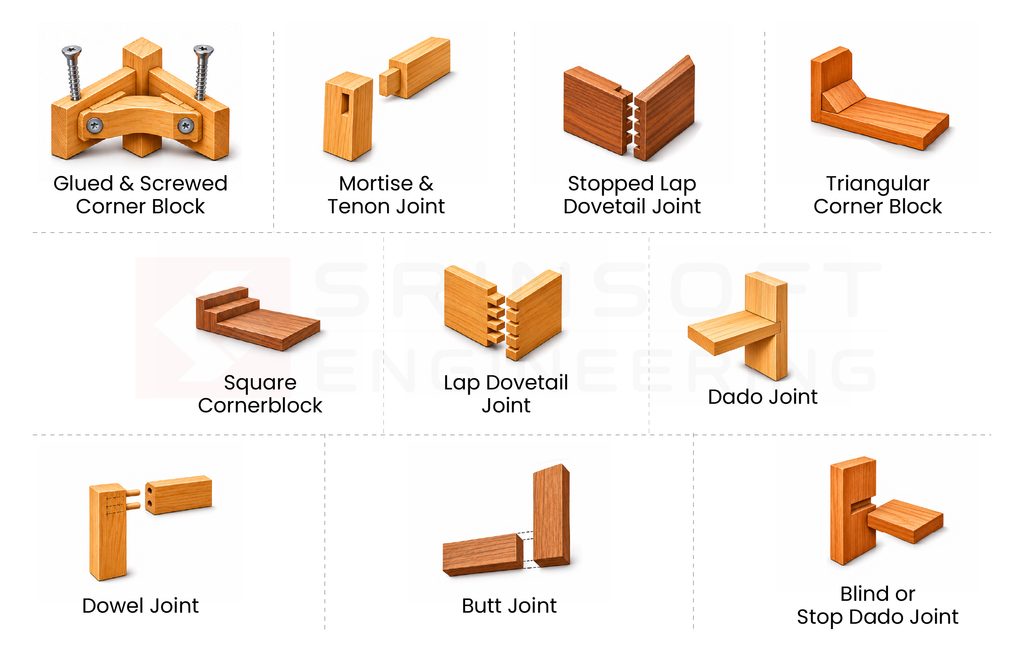
Joinery decisions directly affect manufacturing, assembly time, structural performance, and installation efficiency.
Whether the project utilises:
- Dado Construction
- Dowels
- Pocket Screws
- Lock-Miter Joints
- Knock-Down Fasteners
Establish the selected method before drafting begins.
When joinery decisions are postponed, shop drawings often require revisions to hole patterns, component dimensions, and machining operations.
Production Benefits:
- Faster Assembly
- Consistency Across Production Batches
- Reduced Installation Time
- Lower Labour Costs
Shop-Floor Impact:
When a draftsperson locks in dowel or dado joinery before drafting begins, it prevents costly late-stage revisions to hole patterns and component dimensions. Establishing these assembly methods upfront guarantees perfect consistency across production batches. This strategic early decision instantly translates into faster shop-floor assembly, drastically reduced on-site installation time, and significantly lower labor costs.
Decision 3: Millwork Details – Finalise Material Selection and Optimisation Strategy
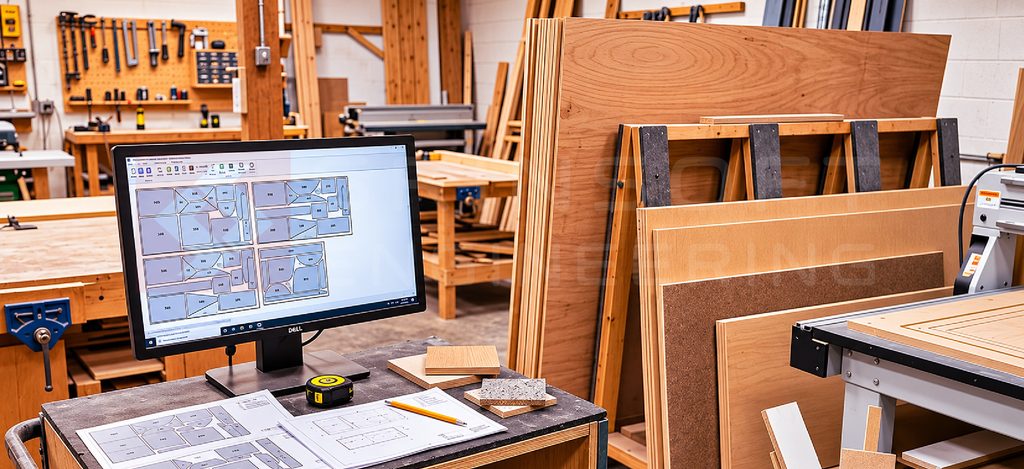
Material choices impact manufacturing costs, machine setup requirements, finishing methods, and delivery schedules.
Commercial millwork projects often include:
- Plywood
- MDF
- Particleboard
- High-pressure laminates
- Veneer panels
- Solid hardwood components
Beyond selecting materials, teams should also determine how sheets will be nested and optimised for cutting efficiency.
Production Benefits:
- Improved Material Yield
- Reduced Waste
- More Predictable Purchasing Costs
- Better Production Scheduling
Shop-Floor Impact:
When a production manager finalises material choices like MDF or high-pressure laminates early, they can immediately optimise how full sheets are nested for maximum cutting efficiency. This proactive strategy drastically improves material yield and reduces costly shop waste. Locking in these exact requirements upfront secures predictable purchasing costs and ensures significantly better production scheduling.
Decision 4: Millwork Drawings – Establish Finishing Requirements Before Drafting:

Finishing is often treated as the final stage of production, but its requirements should be considered much earlier.
Different finishes can impact:
- Edge treatments
- Surface preparation
- Assembly sequence
- Grain orientation
- Component handling
For example, painted MDF requires different detailing than stained walnut veneer. Likewise, prefinished materials may dictate unique machining and assembly workflows.
Production Benefits:
- Consistent Appearance
- Reduced Finishing Defects
- Fewer Production Bottlenecks
- Improved Quality Control
Shop-Floor Impact: When a drafting team establishes whether a project uses painted MDF or stained walnut veneer upfront, they can instantly adapt edge treatments and assembly sequences. This foresight prevents late-stage rework and drastically reduces finishing defects. Addressing these requirements early ensures a perfectly consistent appearance, improves quality control, and completely eliminates costly production bottlenecks.
Decision 5: Commercial Millwork Shop Drawing – Plan for Installation and Field Conditions:

Shop drawings should support more than fabrication; they should facilitate successful installation.
Large reception desks, wall panel systems, retail fixtures, and office millwork often encounter site-specific challenges such as:
- Elevator size restrictions
- Tight corridors
- Uneven floors
- Existing MEP services
- Phased construction schedules
Ignoring these constraints during drafting can result in expensive field modifications.
Production Benefits:
- Fewer Field Issues
- Faster Installation
- Reduced Project Risk
- Improved Client Satisfaction
Shop-Floor Impact: When a millwork detailer anticipates site constraints like tight corridors or elevator restrictions during drafting, they can split large reception desks into modular units. This foresight completely prevents expensive on-site modifications and ensures drastically faster installation. Accounting for field conditions upfront guarantees fewer field issues, significantly reduces project risk, and ultimately improves client satisfaction.
Commercial Millwork Drafting Services – The First Cut Is Made on the Drawing Board
A master cabinetmaker knows the pencil decides the precision long before the saw does.
If the saw doesn’t care what the drawing intended, the responsibility falls squarely on the engineering that comes before it.
Production-ready millwork shop drawings must account for machine capabilities and tooling, joinery and assembly methods, material selection and sheet optimisation, finishing requirements, and site-specific installation conditions. Every cut, joint, grain direction, finish detail, and assembly sequence must be resolved before production begins.
That is where manufacturing reality meets detailing expertise.
At SrinSoft, our millwork engineering team translates these five production decisions into fabrication-ready documentation. From validating CNC machining capabilities and joinery details to optimising material yields, defining finishing requirements, and planning for site installation, we develop millwork shop drawings that align with your manufacturing processes and on-site realities.
Bring Us the Workflow
Stop burning bench hours fixing what should have been resolved in CAD.
Share your architectural design drawings, material schedules, hardware specs, and shop equipment standards. Our engineering team will review your project requirements and deliver a comprehensive technical scope and fee proposal within 24 hours. No sales fluff – just production-ready engineering built for your machines.
Request a Technical Scope & Proposal
Why should equipment be checked before drafting?
Equipment capabilities determine what can be manufactured efficiently and accurately, so designs should match what the shop can actually produce.
Why is joinery important in millwork?
Joinery determines how components connect, affecting overall strength, assembly time, and installation efficiency on every project.
Why is material selection important?
Materials affect a project’s cost, durability, appearance, and manufacturing processes, so choosing the right ones influences both quality and efficiency.
What is grain direction in millwork?
Grain direction is the orientation of wood grain or veneer patterns on visible surfaces, which affects the finished look.
What is the biggest benefit of planning before drafting?
Better planning reduces mistakes, saves time, and improves overall project efficiency from the drafting stage through production and installation.