[ Sep
15-17
] Save the date for Autodesk 2026
[ Sep
15-17
] Save the date for Autodesk 2026
 Email:
inquiry@srinsoft.engineering
Email:
inquiry@srinsoft.engineering Phone:
+1 (614) 552-3888
Phone:
+1 (614) 552-3888



 Add Us On Google
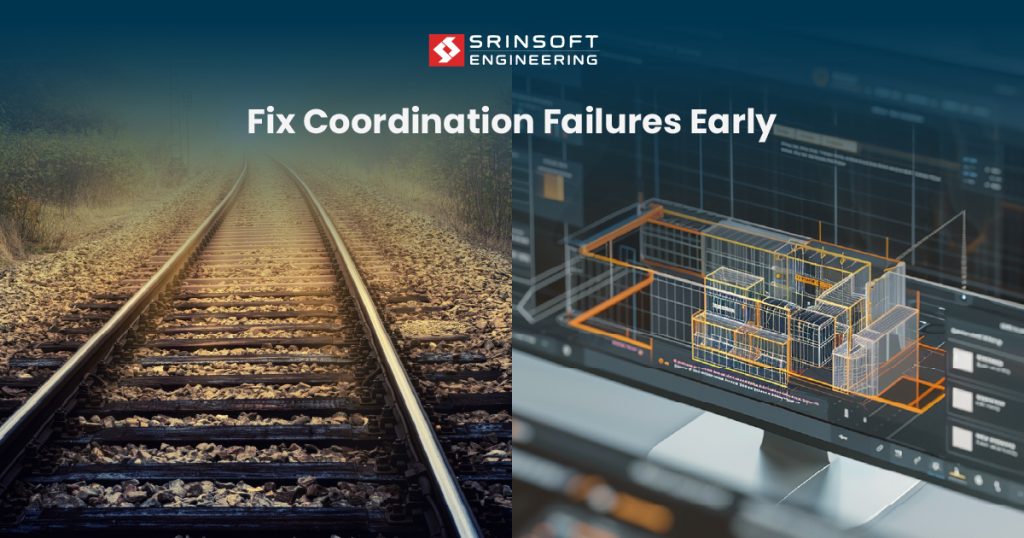
Ballast does the work. Steel gets the credit.
In rail tracks, ballast is what distributes load, maintains alignment, and absorbs stress long before visible failure occurs.
And in complex construction projects, coordination plays the same role.
Structural BIM Coordination – The Cost of Inaction
When structural BIM is not treated as the coordination backbone, expect:
- Re-coordination cycles after “approved” milestones
- RFIs driven by confusion about the positions, not design complexity
- Fabrication packages built on misaligned datums
- Temporary works designed on incorrect structural assumptions
- Procurement delays from spec-model discrepancies
- Program recovery attempts that trigger structural rechecks
- Erosion of contractor confidence in the federated model
Structural BIM models reinforce coordination before execution begins. Here are five failures they prevent. These are workflow failures.
Issue #1: BIM Clash Detection Against Immature Models
Structural BIM Modeling: Most problems with clash detection come from running it against the wrong models, at the wrong LOD, at the wrong time, and calling that BIM coordination.
Most persistent clashes trace back to three things:
- Late model submissions compress review cycles, leaving little time to resolve clashes before sign-off and pushing unresolved issues to site.
- LOD mismatches where structural reaches LOD 300–350 while MEP remains at LOD 200 or early 300, producing clash reports that look clean but fail once services are fully developed.
- And parallel workflows where disciplines develop in isolation and converge only at coordination meetings, by which point changes are expensive and nobody wants to own them.
Structural models often become the earliest stable reference and can set the coordination baseline.
That means defining LOD expectations per coordination milestone, and treating the structural model as the anchor of the federated model.
Example: A hospital project runs clash detection at 60% CD stage. Reports come back clean. Three weeks later MEP updates their model with fully coordinated ductwork — now 340 clashes in the plant room alone.
Issue #2: Uncontrolled Datums in Federated Models
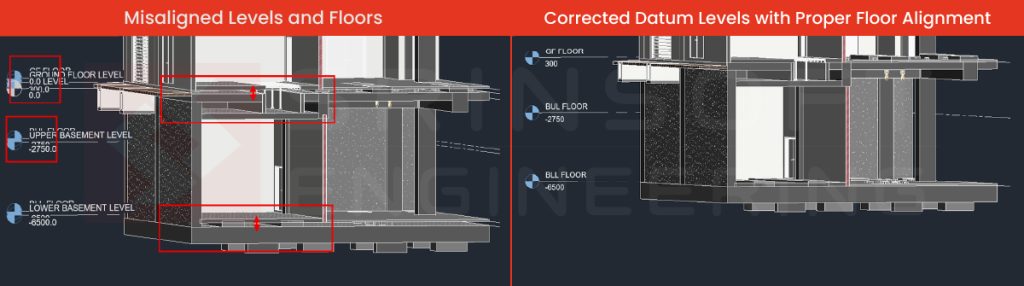
Things accumulates quietly, one discipline referencing finished floor levels, another working to structural slab, a third importing coordinates from a survey point that was never formally established as the shared project reference.
A 50mm datum discrepancy in early design becomes a 50mm discrepancy in every updated model that references it. By the time it surfaces, usually during fabrication alignment, it’s embedded in hundreds of elements across multiple disciplines. Unpicking it is a coordination crisis.
A coordination protocol led by survey control and structural reference geometry prevents this, because the project establishes a single shared coordinate system and level structure early in the model setup. Shared coordinates, agreed levels, a single survey point formally adopted across all disciplines from project start. When structural owns that baseline and enforces it at federated model setup, the problem doesn’t compound — it doesn’t start.
Example: Structural models to structural slab. Architecture models to finished floor levels. The offset between them is never formally documented or shared in the coordination model. Eight months in, the facade contractor imports both models to start panel sizing — and every floor is 40mm out across the entire building envelope.
Issue #3: Hidden Construction Sequencing Assumptions
Structural engineers constantly make sequencing decisions, such as determining concrete pour sequences based on movement joints. Propping assumptions that determine how loads transfer between slabs during construction and how long temporary supports must remain in place. Steel erection logic that determines which connections can be made permanent and when.
The result is a 4D program built against geometry with no awareness of the constraints behind it. The contractor sequences based on what looks logical spatially, not what the structural design actually requires. Temporary works may be designed without full visibility into the propping and staging assumptions used in the structural design. A pour sequence is changed to suit the schedule, and no one flags that the new order alters the deflection assumptions used in the design calculations.
The sequencing logic lives in calculation packages, engineer’s notes, and meetings that the contractor wasn’t in. Bridging that gap means working with the structural engineer to surface those assumptions explicitly — model phasing that reflects pour sequences, element naming that communicates construction stage, 4D links that are built around structural logic rather than just program logic.
Example: A contractor reorders the pour sequence on a post-tensioned deck to recover two weeks of program. The structural engineer had assumed a specific sequence to manage long-term deflection. Nobody told the contractor. The slab begins behaving outside the deflection assumptions used in the design and a remediation assessment eats the two weeks back and then some.
Issue #4: Change Without a Model of Record
Late design changes are inevitable. Without a clear model of record driving updates, this is what happens. Architect issues a revised floor plate. Structural updates the model. MEP doesn’t receive the notification, or receives it too late, or receives it but hasn’t federated the latest structural model yet. The coordination model being reviewed in the next clash session is already out of date. Nobody knows whose model is current. The RFI log starts growing.
Structural is the natural anchor for change control because structural changes have the broadest downstream impact. A column shift affects architecture, MEP routing, facade, and foundations simultaneously. When structural BIM is treated as the coordination backbone, change notifications flow from it. Other disciplines update against it. The federated model has a clear hierarchy.
Example: Architect shifts a core wall 300mm in response to a tenant requirement. Structural updates the model. MEP coordinates against the previous version for another three weeks before anyone notices. Eighteen RFIs and a re-coordination session follow.
Issue #5. Specification Data That Never Reaches the Model
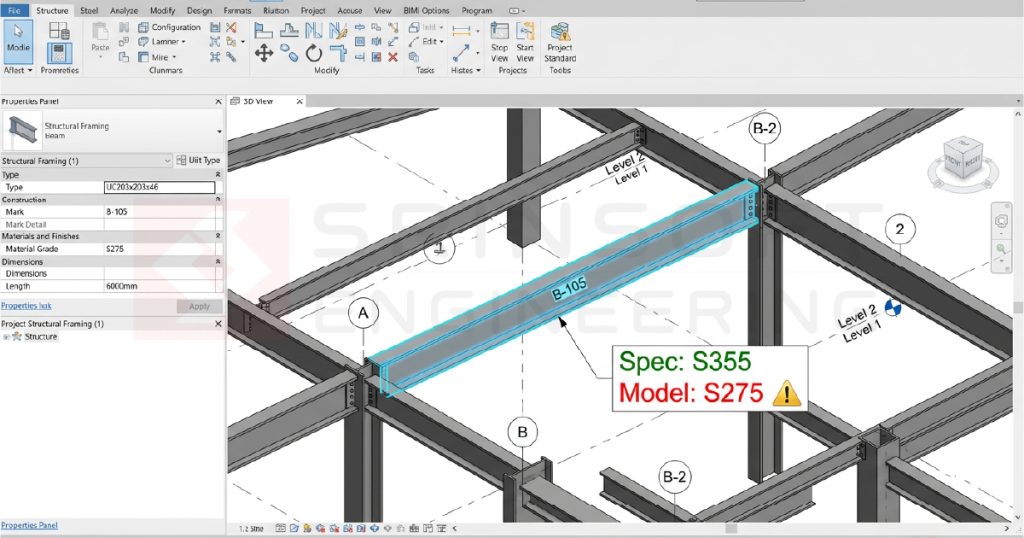
The model shows one thing. The specification says another.
It shows up in predictable places. Steel grades that were updated in the spec after a value engineering exercise but never reflected in the model. Fire ratings on structural elements that conflict with what the passive fire protection package is designed around. Connection details that exist in the calculation package but have no model representation — so fabricators are working from geometry that doesn’t communicate the full design intent.
Making the structural model a genuine single source of truth requires two things most projects skip. First, a formal link between specification updates and model update obligations — when the spec changes, the model changes. Second, model attributes that actually carry specification data. Material grades, fire ratings, surface treatments embedded in element properties.
Example: Steel fabricator prices the job from the model. S275 throughout. Value engineering six months prior had upgraded connections to S355 in the spec. The discrepancy surfaces during procurement. Reorder, delay, cost delta — all of it avoidable.
Coordination Is a Structural Problem
Coordination failures follow predictable patterns — late models, misaligned datums, assumptions that never leave the engineer’s calculations, changes that propagate without an anchor. The BIM manager’s job is to build the workflow that makes late-stage surprises structurally impossible.
A mature structural BIM model doesn’t just reduce RFIs. It changes who controls the project during execution.

If you’re working on a complex project and the structural BIM model isn’t doing that work yet, that’s the gap worth closing.
The best practice in any discipline is to continuously link the structural model with other models like ID, landscape, and architecture. Regularly reloading and coordinating models prevents many future clashes.
SRINSOFT Engineering delivers high-end structural 3D BIM modeling services and deliver models built for coordination, not just compliance. Explore how we structure models to eliminate late-stage coordination risk.
FAQs
1. Why are clashes still happening even after running Navisworks weekly?
Clashes occur when the structural model is not actively coordinated with other disciplines like interior design, landscape, and architecture.
Expecting a 100% clash-free model at the initial stage is unrealistic. Early-stage models are still evolving, with incomplete data and inconsistent levels of detail. The goal is to identify critical issues early and reduce coordination noise as the model matures.
2. How do I enforce consistent levels and shared coordinates across all disciplines?
Issue a formal coordination baseline early. Lock shared coordinates, levels, and survey points before federating. Reject models that don’t comply.
3. How can structural sequencing assumptions be reflected in the model?
Use phasing, construction-stage parameters, and 4D links. Embed pour sequence and propping logic visibly instead of leaving it in calculation notes.
4. Who should own change control in a federated BIM environment?
The discipline with the widest downstream impact. Typically structural. Establish a model of record and require updates to reference it.
5. How do I prevent spec and model mismatches before procurement?
Link specification revisions to mandatory model updates. Embed material grades and fire ratings as element parameters, not external documents.
TL;DR
Most persistent coordination failures follow predictable structural patterns. They are not random clashes. They stem from LOD drift, uncontrolled datums, hidden sequencing logic, unmanaged change, and spec-model gaps.